"Prof. Rich Krevolin's class was the best class on writing I ever took. Many of the lessons he taught me are still with me as some of the most important elements of my writing process." -- DANNY STRONG, award winning writer of Lee Daniels' THE BUTLER, RECOUNT, GAME CHANGE
"Prof. Krevolin has a tremendous critical eye. Because of his insightful and specific notes given while writing my first book, DRIVING THE SAUDIS, quickly became a New York Times Bestseller and a People Magazine Top Books Pick. He has a thorough understanding of story elements and structure, accompanied by a compassionate and generous nature -- and his ability to convey his knowledge is unsurpassed. Don't send out a manuscript or screenplay without consulting with him first!" -- JAYNE AMELIA LARSON, author of the nonfiction New York Times Bestseller, DRIVING THE SAUDIS (Simon & Schuster, 2012)
"Rich was a Professor of mine while I attended USC Film School and he was always such a great and positive teacher and supporter of me and my work!" -- ERIN O'MALLEY, Producer, CURB YOUR ENTHUSIASM, NEW GIRL, DA ALI G SHOW, THE SARA SILVERMAN SHOW.
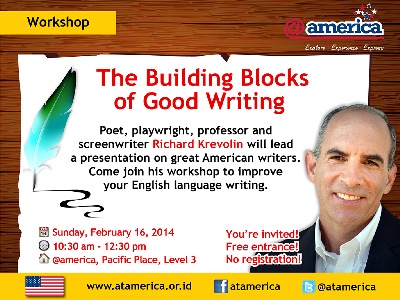
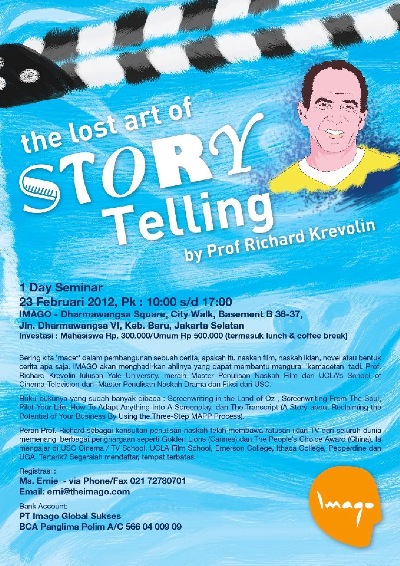
I will be teaching once again in Jakarta in February.
Here are the three courses I will be teaching.
If you happen to be in Indonesia and want to join us, do come to the lectures.
Thanks.
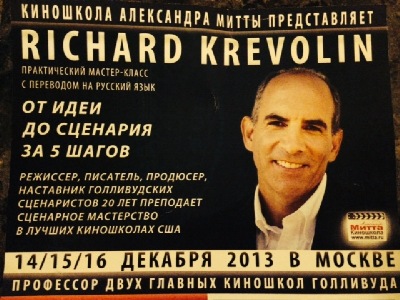
BREAKING NEWS: Russia is filled with people who love films and Hollywood!
I just returned from a class in Moscow.
Lots of excitement there about writing and learning all about craft from American teachers.
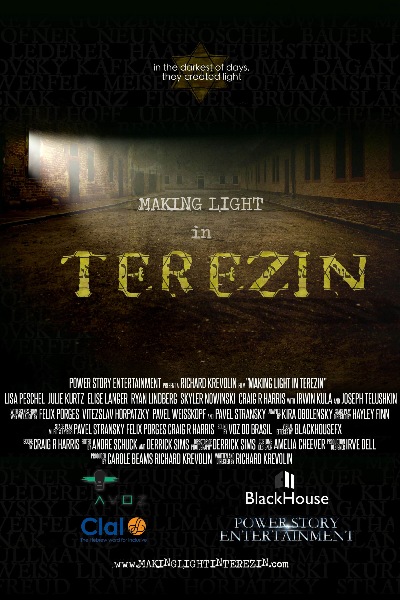
After more than 2 years of writing, directing, producing, editing and editing and editing, my new feature length documentary is finally finished!!!
AMEN!!!
This one is special and tells the story of how theater and comedy saved the lives of people during the Holocaust.
It's been submitted to a bunch of film festivals and now I'm waiting to see where it will premiere.
Hope you get to see it soon.
If you happen to be in Indonesia, please join me for some amazing seminars.
It should be a tremendous learning experience.
In this new lecture, I will teach how to better understand cinema and get more out of movies.
This one will be a fabulous chance to see what it's like to spend a weekend in film school and get expert feedback on your writing.
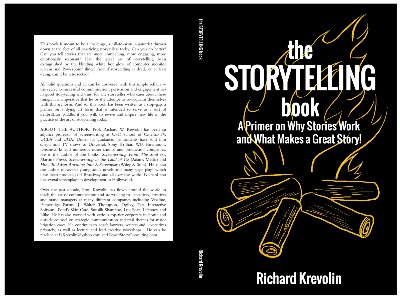
MY NEW BOOK CO-AUTHORED WITH ELIANA BARBOSA IS OUT!
It is being launched in the US and Brazil.
Check out the English and Portuguese language versions...
Do you like the American cover or the Brazilian cover better?
Here's an excerpt from a recent article about one of my students who just got their first book published...
"Dr. Marc Hirsch retired from medical practice after moving to Bowling Green four years ago. He was born in New York City, attended the Bronx High School of Science, then college and medical school at Boston University. He is married, the stepfather of a daughter and son, and the grandfather of two teenage girls. Having studied writing under the supervision of prolific Los Angeles author and screenwriter Richard Krevolin, Hirsch is proud to announce that his first book is due to be released this month; “The Case” is a mystery set in New York about the accidental violent death of a doctor. Hirsch will be signing copies at the Horse Cave BookFest on June 30th from 9 to 5, as well as other locations around the country."
TEACHING A SEMINAR IN JAKARTA.
HOPE TO SEE YOU THERE!
My play, "THE GOSPEL ACCORDING TO JERRY" was just named by Minnesota StarTribune Head Theater Critic, Graydon Royce, as one of the TOP TEN plays produced in Minnesota in 2011!
In other news: This past Summer I was in Prague in the Czech Republic where I directed a documentary, "MAKING LIGHT IN TEREZIN" about how the Jewish prisoners in the Terezin Ghetto used comedy, song and dance to survive the holocaust. I'm i n Post-Production now and hope to have a final cut in 2012. If you'd like to see the trailer, please feel free to email me...
Check out this article from the LA TIMES:
Born on Broadway isn't a sure pedigree
By Randee Dawn, Special to the Los Angeles Times, November 17, 2011
This fall, theater fans may be in for a little déjà vu: "Carnage,""Ides of March," "A Dangerous Method" and "War Horse" are all films, opening from October through December, that have been adapted from plays. All are also popping up with early buzz, making for an exciting Academy Award season for filmmakers and playwrights alike.
So what's with the rush to adapt from the stage? Perhaps it's because plays come with established credentials. As Richard Krevolin, author of "How to Adapt Anything Into a Screenplay," notes: "They're a brand, and there's a feeling of security that if a stage work does well around the world, the investment in the film is more secure than an original screenplay."
Or maybe, as "Method" filmmaker David Cronenberg suggests, they're shorthand for "studio executives who don't seem to know how to read scripts anymore. They can't visualize anything. But if there's a play, they can go and watch."
Whatever the reason, the bad news is that the curtain rarely rises for serious plays in Oscar season. Voters like musicals ("Chicago" won best picture in 2003; Jennifer Hudson won for "Dreamgirls" in 2007), but even there pickings are slim. No play adaptation has won best picture since 1989, when "Driving Miss Daisy" earned four Oscars. Some may make shortlists — "Doubt" and "Frost/Nixon" had five nominations in 2008, and five losses, while last year's "Rabbit Hole" got Nicole Kidman a lead actress Oscar nomination — but their races ended there.
Studios are clearly banking on making more of an impression this year, though whether a film's provenance as a play has any resonance in the finished project depends largely on the directors' choices. The Roman Polanski-directed "Carnage" is a near-literal transfer from Yasmina Reza's "God of Carnage," says producer Saïd Ben Saïd, because "Roman didn't want to tell a story different from the original."
Instead, he says, the film and the play evolve in real time. "It's very difficult to make a film like that," he says. "'Carnage is an experimental movie, but in the meantime, it's also a movie for a very large audience."
Cronenberg brought in original playwright Christopher Hampton to adapt "The Talking Cure" (which itself was adapted from an unmade Hampton script) into a new screenplay for "Method." What emerged out of a two-act play was an 80-page script.
"David has a genius for economy; I was impressed by the way he pared down every scene to its essentials," says Hampton.
"It was a very adult collaboration," says Cronenberg.
Such meetings of the minds aren't always possible; for "Ides of March," producer Grant Heslov says he and star-director-producer George Clooney liked Beau Willimon's "Farragut North" play from a "thematic point of view" but made deep changes in their own script. For example, Clooney's screen role as a politician existed only offstage in the play.
"You want to open up a play so you can tell the story with pictures rather than words," says Heslov. "Writing in the theater, the playwright is king — you can't even change his or her words. But in the screenplay business, it's much more fluid and loose. The director is definitely king."
Meanwhile, Michael Morpurgo had written the novel "War Horse" that Nick Stafford based his play on, but screenwriter Richard Curtis took over for the film version. Curtis based his screenplay more on the book than the play, but he says the existence of the play itself helped him "be brave" about his own adaptation.
"My tendency would be to be extremely respectful of a book I like," he says, "and since the play took great liberties with the book while seeming fundamentally the same, I think people who have read the book and seen the play and see the film feel like they'll see the same thing — but with all the different qualities you can only get on film."
It remains a tricky line to walk: how literal to make the work and what version is likely to best work with both audiences and award voters. Truth is, plays often make bigger splashes on television than the big screen: The 2003 adaptation of Tony Kushner's "Angels in America" won 11 Emmys and five Golden Globes for HBO.
Still, Krevolin seems to agree with Heslov: Movies expand the limited scope of plays and, in the process, improve them. "In Shakespearian plays, someone will run onstage and talk about a battle, but the beauty of film is we can see a thousand extras engaging in a battle," Krevolin says. "There can be an excitement in opening up a piece of theater to make it come alive on a much grander scale on film."
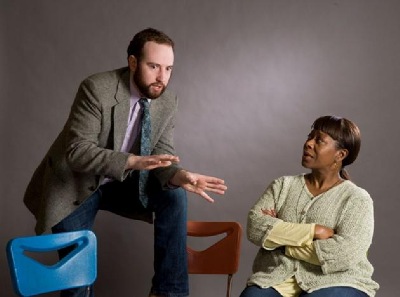
And below find an action photo from my new play featuring two amazing actors, Ryan Lindberg and Greta Oglesby.
(Just in -- a review from the biggest paper in Minnesota.) "Playing with
ideas on religion"
Reviewed by:
Graydon Royce, Minnesota Star Tribune, April 19,
2011 -
An
unlikely friendship sheds light in two directions about faith, race and
political correctness.
Once playwrights Richard Krevolin and Irwin Kula clear their throats,
they have some trenchant things to say about race, religion and human
kindness in "The Gospel According to Jerry." The two-actor piece had its
world premiere last weekend at Minnesota Jewish Theatre Company, with
actors Greta Oglesby and Ryan Lindberg providing a brisk and engaging
portrait.
Lindberg plays Jerry, a rabbi who exhorts his congregation during the
Mourner's Kaddish to uphold Jewish distinctiveness -- a controversial
position introduced after World War II to preserve the tribe. He also
has great confidence (though he never seems smug) in his advocacy for
civil rights and political correctness. He's a hip, happening, secure
guy with an intellectual righteousness. Spiritually, though, he is so
disconnected and hollow that he won't visit his aged mother because it's
"difficult to see her that way."
Oglesby's Nia Thompson leads her church choir with a voice that
reaches deep inside her soul. Shy and wary of Jerry when they meet at
Overeaters' Anonymous (he's the group leader), she slowly opens up to
him and even takes his suggestions to play with tradition in her
worship, maybe even to introduce gender-neutral language.
The overeaters' meeting is a device that brings the characters
together. Once we're past that, Krevolin and Kula get to the real
business: a series of contentious arguments that explore white liberal
self-satisfaction at helping African Americans, and whether religion
loses its savory richness when it becomes an exercise of the head rather
than the heart. Jerry tells Nia, after visiting her church, that he
felt spiritual joy for the first time when hearing the song and praise
of the congregation.
Buoyed by his experience, Jerry helpfully encourages Nia to introduce
the concept of God as mother in her church singing. It goes badly, and
Nia viscerally reminds Jerry that her congregation doesn't have the
luxury of political correctness; members are trying to make sure
families are fed and clothed. Making like a social engineer may please
Jerry but for Nia, it's just another example of liberal meddling.
The transformational power of this play expresses itself in Jerry's
evolution as a feeling creature. Nia cracks open his vulnerability about
his mother, and we come to see that her religious philosophy opens up
and challenges his ideas on exclusivity. Ultimately, Nia replenishes
Jerry's arid spirituality.
Krevolin and Kula might build better connective tissue in "Gospel,"
but that feels like a nit after watching the play to its conclusion.
This is a script full of ideas and leavened by a message that favors
love and kindness. It is brisk, unsentimental and honest. Lindberg and
Oglesby dig into their characters with an audacious grasp for the issues
and, fortunately for us, Oglesby has several opportunities to share her
gorgeous singing voice. Hayley Finn directs with a keen feel for the
propositions being made by Krevolin and Kula.
This truly feels like a
play that needs to be seen for what it has to say."
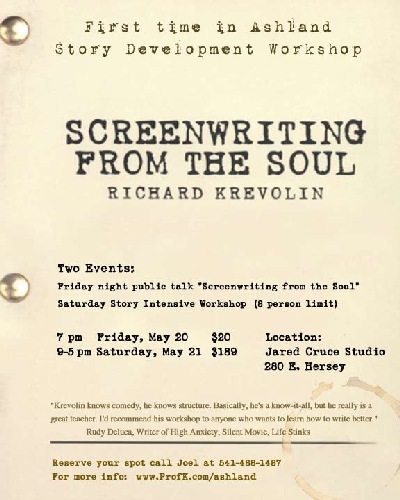
A workshop in Ashland.
Hope you can make it...
Good news:
My new writing book is out. This one uses the paradigm of the structure of the Wizard of Oz as its basis. It also takes the convention of the epistolary novel and uses emails back and forth as the basis for its content. Enjoy...
Just hope nobody goes blind trying to read it all on that tiny little IPhone screen.
Eventually, it might get printed on paper and published, you know, the old school way, but at least for now, this is the only way to get it.
but soon, the IPad awaits, yes?
Enjoy and please do email me and tell me what you think.
My play, Lansky is now running in Tel Aviv in Yiddish.
And so, if you happen to be in Israel, please go by the theater and say hello Yacov Bodo, the spectacular actor in this one man show.
And remember, everything in Yiddish sounds better!
Holiday News:
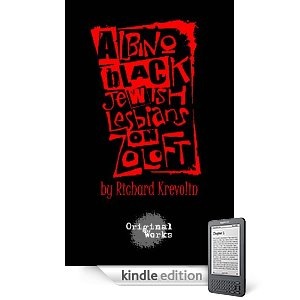
A fun, wacky X-Mas play I wrote a few years ago
has been published by Original Works Publishing and they are doing a
big push right now to try to get it produced around the country during
the holiday season.
If you want to read it, please visit their website and check it out.
It's a series of 12 ribald monologues, one for each of the twelve characters in the famous 12 days of Christmas song... Lots of holiday fun...
Now, I want this site to be a good place to find out information about the art and craft of storytelling, but I also want it to be different than the other storytelling websites out there. And so I thought that a good way to do that might be by starting with these images below...
Now, I thought this photo would be the most popular, since it is cute and has a loving family scene of Momma and her new born chicks and even a few roses. But NOPE, nobody really noticed it...
So, I got a little artistic and decided to post this more dramatic shot.
Now, I thought, for sure, people would dig this one the most since its got a sense of action... But, still no big response. So, I concluded my story is still not as engaging as it has to be.
Voila, I added this picture... Now, this photo features the one and only Thomas the Cat who happened to waltz by and check out the chickadees. Please note, Thomas is a member of the actor's union, (he is Morris the Cat's body double) so I didn't expect him to show up since it was a non-union shoot, but he decided to grace us with his presence anyway. Thomas' stare adds a sense of tension to the photo that was not in the first two. The truth is I think the viewer creates an entire story around it -- a story that they write in their head... What do you think?
Thomas couldn't take the tension and decided to ATTACK! Fortunately for everyone, Momma is one mean girl when her chicks' are in jeopardy, so she readily dispatched him and a moment later, Thomas ran away in disgrace and the chicks were safe... Since this one is so dramatic, I thought for sure that it would be the most popular, but alas, it wasn't... Yep, you guessed it, the one before of Thomas waiting to pounce captured the imagination of my audience far and away more than all the others combined. So, I thought to myself, what does this say about story, tension and drama?




















 I will be teaching once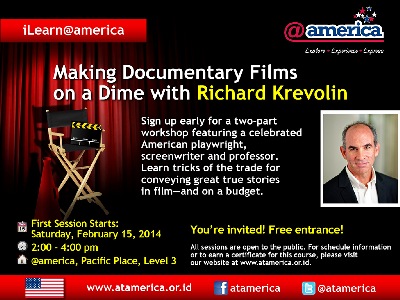
 BREAKING NEWS:
  After more than 2
 If you happen
 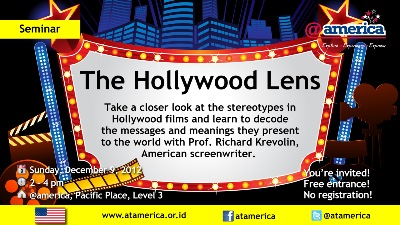 In this new
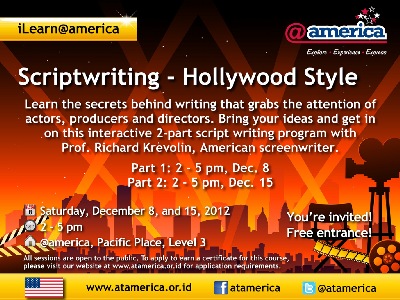 This one will be
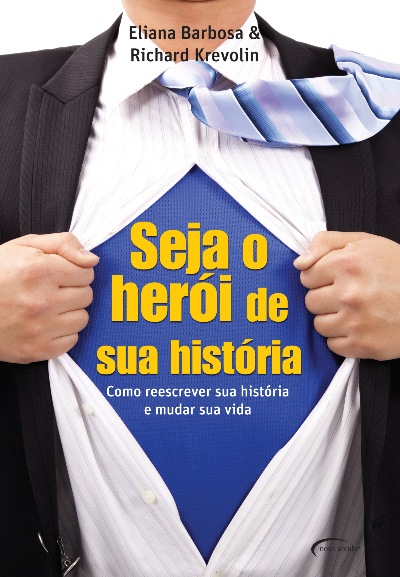 MY NEW BOOK
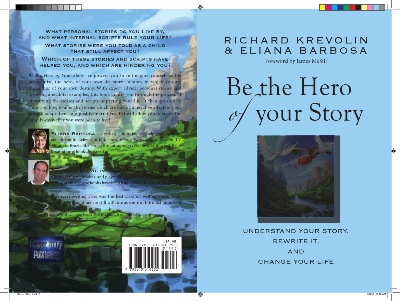 Do you like
  TEACHING A

 I was recently asked
  (Just in -- a review from
  A workshop in Ashland.
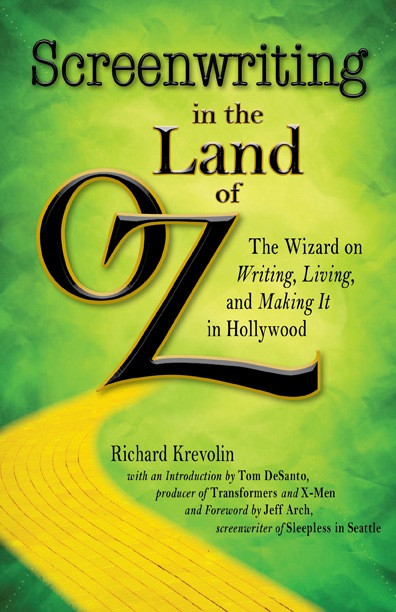 Good news:
  And further shameless self-promo...
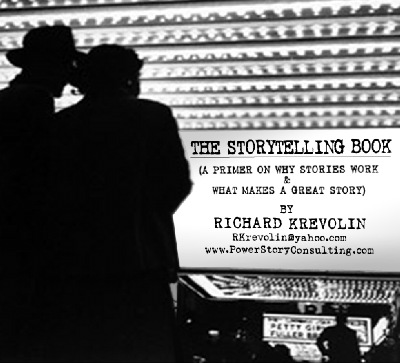 Just finished a new book that is now available to be downloaded on ITunes.
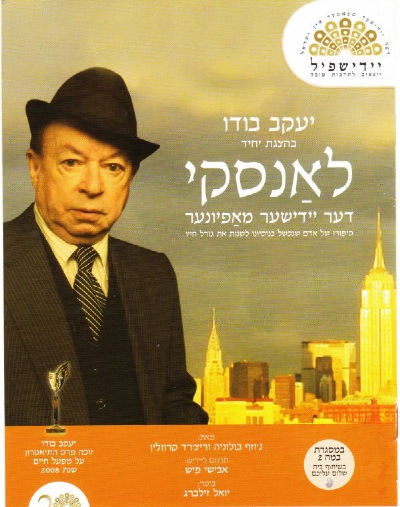 My play, Lansky is now running in Tel Aviv in Yiddish.
 Holiday News:
  Teaching
  Now, I thought this photo would be the most popular, since it is cute and has a loving family scene of Momma and her new born chicks and even a few roses. But NOPE, nobody really noticed it...
 Now, I thought, for sure, people would dig this one the most since its got a sense of action... But, still no big response. So, I concluded my story is still not as engaging as it has to be.
 Voila, I added this picture... Now, this photo features the one and only Thomas the Cat who happened to waltz by and check out the chickadees. Please note, Thomas is a member of the actor's union, (he is Morris the Cat's body double) so I didn't expect him to show up since it was a non-union shoot, but he decided to grace us with his presence anyway. Thomas' stare adds a sense of tension to the photo that was not in the first two. The truth is I think the viewer creates an entire story around it -- a story that they write in their head... What do you think?
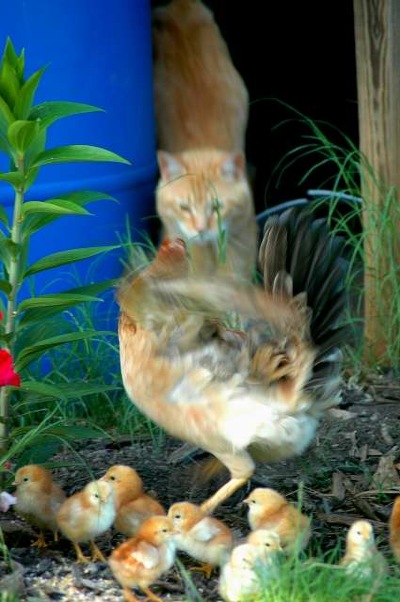 Thomas couldn't take the tension and decided to ATTACK! Fortunately for everyone, Momma is one mean girl when her chicks' are in jeopardy, so she readily dispatched him and a moment later, Thomas ran away in disgrace and the chicks were safe... Since this one is so dramatic, I thought for sure that it would be the most popular, but alas, it wasn't... Yep, you guessed it, the one before of Thomas waiting to pounce captured the imagination of my audience far and away more than all the others combined. So, I thought to myself, what does this say about story, tension and drama?